In accordance to the FTC guidelines, I must state that I make no monetary gains from my reviews or endorsements here on Confessions of a Literary Persuasion. All books I review are either borrowed, purchased by me, given as a gift, won, or received in exchange for my honest review of the book in question.
Showing posts with label Non-Fiction. Show all posts

01 December, 2013

Book review: How Long Will I Cry? Voices of Youth Violence

Title: How Long Will I Cry? Voices of Youth Violence
Editor: Miles Harvey
Publisher: Big Shoulders Books
Publication Date: 2013

This book is a companion to the play How Long Will I cry? that was produced by the Steppenwolf Theater in 2013.

The final version of this book was a collaborative effort by the creative writing students at DePaul University located in Chicago, IL. It uses collaborative story-telling methods to collect the real stories of people in Chicago whose lives have been touched by violence.

Chicago is still extremely racially divided. recent information given by the country France to it's tourists coming to visit the city tells it's citizens to avoid whole sections on the South and West sides of the city due to the mortality and crime rates.

This book takes stories of many types of people from many areas of the city to talk about the impacts of violence caused by and to the youth of the city of Chicago. Story types range from those of families who have lost children, community member in neighborhoods affected by violence who are working to change the neighborhoods in positive ways, stories told by both current gang members and ex-gang members, and youth who have been affected by the violence in many different types of ways. The stories while mainly focused on the South and West sides of the city also show how ares on the North and Northwest sides of the city are being affected by gang related violence.

This book impacted me in ways that I wasn't expecting. The stories, while predominantly sad, and filled with rage and hopelessness also had hope sprinkled through it's pages. Stories were shared by people who were trying to make a difference after loosing their own loved ones to violence. At the end of the book there is a list of organizations who are trying to work against youth violence in the city and while one could be disheartened by the length of the list, it is amazing to see how many people care about changing the city that I live in.

As a life long resident of Chicago my entire life I was spared  the effects of neighborhood gang violence until my late teens. I grew up in a neighborhood on the Northwest side that was predominantly white, with a strong Irish and Polish element to the families living in it. when I was in high school I attended a magnet school which drew students from all parts of the city, and was very racially diverse. I made friends from outside of my own neighborhood and sadly lost one to gang related violence right after graduation. There were times going out when I knew I had to either go home before a certain time or call for a ride home because it wasn't safe to wait for the CTA where we were.

This book is being given to readers for free through various events to promote awareness of the issue and by request to Big Shoulders Books which is a very big thing. By making the book free it will help get it into the hands of people who might not be able to buy a book, and the publishers encourage readers to pass their copy along to another reader when they finish. I was 1/4th of the way through the copy I was reading before I passed it onto a sociology student at NEIU That I had just met after it sparked a conversation between she and I. I plan on passing this copy on through one of the little free libraries that have popped up on the North/Northwest side of the city to hopefully find a new reader to touch.

Readers who are interested in acquiring their own copy of this book can visit Big Shoulders Books page about the book to request a free copy.

10 December, 2012

Book Review: True Spirit The True Story of a 16-Year-Old Australian Who Sailed Solo, Nonstop, and Unassisted Around the World by Jessica Watson


Title:True Spirit: The True Story of a 16-Year-Old Australian Who Sailed Solo, Nonstop, and Unassisted Around the World
Author: Jessica Watson
Publisher: Atria Books
Publication Date: September 7, 2010

After 210 days at sea, Australian teen Jessica Watson sailed into Sydney Harbor on May 15 2010 completing a trip that circumnavigated the globe. Jessica sailed a 33 foot boat nonstop through some sever weather conditions unassisted to complete her dream of becoming the youngest person to sail around the world. At an age where most teenage girls are thinking of boys and school and clothes, Jessica took a dream that many adults would not get a chance to fill and with the help of a very supportive family and a team of experts on sailing, weather, and mechanical parts made that dream a reality.

I thought that this was an interesting book.

Since I first stumbled on a copy of Dove back in high school, I have loved travelogues that involve sailing. I've done a little sailing on Lake Michigan, nothing larger than a 19 foot boat (with no motor just sails only). It was something that I have enjoyed doing a lot, and now that I don't I enjoy reading about other people's sailing adventures.

I thought it interesting that Jessica took her blog entries made during her sailing and expanded them for the book. It showed her immediate reactions to situations, as well as what she remembered afterwards. It's a shame her trip is not recognized by certain sailing organizations as circumnavigating the globe (and that there is not a youngest sailor record anymore). However, you get the idea that while it might have been nice to have her name put to a sailing world record, Jessica is more thrilled with the fact that she dreamed making this trip and actually getting a chance to fulfill it. It was refreshing to witness this journey through Jessica's own words without the passage of time between the events that happened, and the writing of the book.

I was a little annoyed by the vast use of QC codes throughout the book linking to her video blogs. As someone who lacks a smartphone I thought this a tad annoying to include as not everyone has the technology to use the codes.

06 December, 2012

book review: All In A Day’s Work for Real Estate Agents: Humorous & Heartwarming Stories


Author: TC McClenning,
Publisher: Work Like a Dog Books
Publication Date: April 2009
ISBN-10: 0982090714
ISBN-13: 978-0982090718

For those people selling a house, it can be hard to do sometimes. This is true for both the house owners and the real estate agents who are showing the house to prospective buyers. Real estate agents are faced with the unexpected at times: unexpectedly discovering a corpse in a home, getting locked out on a balcony while doing a walkthrough, learning that the pets who were supposed to be out of the
home for the showing are still in the house, and angry at strangers coming inside, or finding wildlife inside the house such as a raccoon or skunk. But despite these negative things, selling a home can be a rewarding and happy experience for the men and women who work hard to sell the homes they have been entrusted with.

All in a Day’s Work for Real Estate agents collects true stories that have been submitted by real estate agents from across the USA into a compelling and funny read. I am not involved with real estate,and I found myself drawn in and laughing along with many of these stories. There were a few of the sections that dealt with terms that were very specific to the trade, but I found there were good introductions that explained those terms to the non real estate savvy. For those readers who do sell homes, they may find that they are not alone, or get to see what other sellers have encountered on the
job. Editor TC McClenning has put together a solid collection of stories that show the hard work, and the above and beyond steps many realtors do to sell their buyers the home of their dreams. This book seems to be a good look into a job that is often overlooked.

03 December, 2012

Book Review: Ambulance Girl by Jane Stern


Title: Ambulance Girl
Author: Jane Stern
Publisher: Three Rivers Press
Publish Date: April 27, 2004

Jane Stern had hit her fifties with a thud. A successful food writer with her husband Michael, she had fallen into depression and had started collecting phobias, and her marriage of thirty years was struggling. A chance noticing of the volunteers needed sign outside the Georgetown, Connecticut fire station put an idea into her head. She was going to become an EMT. She, who had trouble helping herself at times was going to help other people in need.

So, she signed up for EMT training through the volunteer EMT program in her township. Despite her fears of being too old, too fat, and too squeemish, Stern found herself doing well in her classes. She passed the local exams, the practical exams, and the national board certification to become an EMT-B. In doing so, she becomes a member of a community of firemen and emergency response personnel that allows her to become more than she expected.

Ambulance Girl is a retrospective of Stern's first year as an EMT. She revisits her struggles through the initial certification process. Her first months as a woman in a male dominated fire department. We see her struggles with her claustrophobia, her fears of dying, and her ongoing struggle with depression. When a good friend suffers a brain hemmorage, and is "saved" only to end up in a long term care facility half the person he was, Stern starts to question her role as an EMT.

I was drawn into this story. I have read a couple of the author's food books, and found this chapter of her life enthralling to read. She shares her journey from neurotic and depressed to the first female officer of the fire station (station secretary) in a way that is both humorous and warm. I found myself turning page after page wanting to know how she was going to handle the next situation.

02 June, 2009

Book Review: Lighthouses of the Golden State: Calafornia's Majestic Beacons by Kent Wymouth


Lighthouses. Their name evokes romantic images of tall wave swept towers. Flashing beacons of intense light across stormy seas to guide tall ships to safety. But unknown to people in these days of GPS navigation, lighthouses still hold an important function for traveling ships. The state of California with it’s rocky and foggy coasts is a perfect location for lighthouses in many forms.

In 1848, with the discovery of gold at Sutter’s Mill, a rush of people flowed into California. The promise of untold riches waiting to be found drew in men from every part of the globe. During their travels, the coast of California and the waters surrounding it were unexplored and dangerous territory to travel through. But as ship travel was the quickest way to the gold fields of San Francisco many ships braved these dangerous and tricky coast lines.

In 1852 the Lighthouse Board was formed. Its goal was to protect the many ships traveling the Californian coasts. This was the start of building many magnificent structures along the coastline. An effort that would result in California having forty three lighthouses built along it’s coastline over the many years. These lighthouses, manned by brave men and women would protect the ships carrying the commerce, supplies, and people that would build the West.

Lighthouses of the Golden State is an impressive book. Author Kent Wymouth spent five years researching letters, diaries, and original documents, as well as visiting every existing structure in the state. The result is an extremely informative yet deceptively slim book. This book explores the forty three lighthouses that have been built in the state since 1852. The author shares the history of each lighthouse, along with a description of how the lighthouse ran, why each lighthouse was built and other informative points of interests such as what type of lens was placed in each lighthouse. Also, each entry has a photo of the lighthouse being discussed. Lighthouses of the Golden State is an extremely thorough chronicle of California’s waterways covering over one hundred years of history.

I’ve been interested in lighthouses since I first saw one of the lighthouses along the shores of Lake Michigan as a child. However, I am not an enthusiast, well versed in the history behind these structures. As such I found Lighthouses of the Golden State an extremely informative book that didn’t overwhelm me with unknown terms. But on the other hand, I can see this book being a great reference for the lighthouse enthusiast, as well as visitors to California’s coasts that might like to try and visit some of the structures. I very much enjoyed the book. It gave me a look at a coastline I’ve yet to visit myself, and left me wanting to see some of these magnificent structures that helped shape California’s waterways and history myself one day.

26 May, 2009

Book Review: The Mighty Queens of Freeville by Amy Dickinson


For Amy Dickinson, family is her cornerstone. After becoming a single mother to a toddler, Amy found herself moving back from London to Freeville, New York to mend her broken heart. It was with the help of her unusual family of single mothers and strong independent women that Amy was able to find a new direction for her life while officially becoming a single mother.

As she moves away from Freeville to Washington DC, Amy finds herself returning to her hometown, and the advice of her supportive family. These strong, independent women provide Amy with advice, love, and help when needed to pick up the pieces of her life and make them whole again. The book spans the years from Amy’s divorce to her daughter going away to college. Well known advice columnist Amy Dickinson shares the many triumphs and failures that she has witnessed over the past twenty years.

The book is divided into topics of interest in the author’s life. These range from subjects such as divorce, becoming a single mother with and without a support net, gaining pets, seeing your child through the teen years and dating as an older adult. Each new topic explored has a tendency to jump back to the time before/leading up to the divorce and expanding forwards through the years. I found it a little confusing at first. However I found myself drawn into Amy Dickinson’s story.

As someone who lived in Chicago when Ann Landers passed away, I remember the hype surrounding the search for her replacement. I’ve read a few of Amy’s column’s. I am more familiar with her work on the NPR programs that she participates on though. It was because of this semi-familiarity that I jumped on the chance to read this book. I wasn’t sure what to expect. I found a wonderfully sweet memoir of the years leading up to Amy Dickinson’s jump into fame. I think that’s what endeared me most about the book. The author focuses on her family and her life at the time rather than how she became important. This is a book that I am going to pass along to my own mother. It is a book that I think she will be able to relate to, as a divorced single mother, and will hopefully enjoy.

07 February, 2009

Book Review: Near Death in the Arctic: True Stories of Disaster and Survival Edited by Cecil Kuhne


Read and reviewed for Armchair Interviews

The Arctic. The very name pulls images of snowy landscapes, harsh weather, and intense travel conditions out of our imagination. Many men and women have raced against the elements to reach the North and South poles.

Near Death in the Arctic is a collection of writings concerning these journeys. Editor Cecil Kuhne has collected previous published writings by explorers such as Captain Roald Fram, Richard E. Byrd, Apsley Cherry-Garrard, David Lewis, and Robert Falcon Scott, as well as second hand writings of expeditions. This collection showcases both first hand experiences in exploring the North Pole, the race to reach the South Pole first, and exploration of the largely unknown continent of Antarctica.

Near Death in the Arctic, transports readers to a time where the world was not fully known, and exploration an important thing. We can learn more about the struggles these explorers faced from the weather, from lack of supplies, and unexpected situations such as their ships being frozen into the pack ice.

Reading this book during the recent extreme cold weather here in the Midwest gave me an appreciation for what these explorers went through. They braved the unknown to bring the world an idea of what was out there. They went to advance our knowledge of the geography of these harsh areas of the world. They went to advance scientific knowledge of the Arctic regions. They went for the glory of exploring. I really enjoyed reading this book because it expanded my knowledge of the explorers who looked for a Northwest Passage from the Atlantic Ocean to the Pacific Ocean. I had been aware of Robert Falcon Scott and Ernest Shackleton’s trips to the Antarctic, but I had not known that Scott was the second team to the South Pole.

I recommend this book to anyone who is interested in reading about the exploration of the planet’s North and South Poles from the turn of the twentieth century onwards.

20 December, 2008

Book Review: Playing with Fire Whining and Dining on the Gold Coast by Thomas G. Schaudel


Read and Reviewed for armchair interviews
Have you ever gone to dinner and had a bad experience? Maybe your food wasn’t cooked right, or you found something that shouldn’t be there in your soup bowl. Perhaps you were witness to one of your fellow patrons being extremely rude and pushy. However, what do you do if you are the chef, and the customer’s complaint is just too off the wall for you to handle?

If you are Chef Tom Schaudel, you write a book about those customers. Tom writes in his introduction: “By my math, I have fed over two million Long Islanders in the last forty years. One million, nine hundred ninety-nine thousand, nine hundred and fifteen have been wonderful; eighty five have made this book.” Playing with fire introduces readers to these most memorable characters that Tom and the staff of his four restaurants have met over the last forty years of being in the business.

From the moment I saw the table of contents which is laid out to look like a menu and the illustrations beginning each chapter, I knew I was in for a treat with this book. Chef and author Tom Schaudel shares these humorous “horror” stories of some of his best worst behaved customers. From the woman who tried to walk out of the restraint with a Christmas tree attached to her pocket, a grandma who liked to flip the bird at everyone in the place when not helped fast enough, the awkward situations of the woman on a date who is so drunk she is passed out on the ladies bathroom floor, and the young married couple who tried to redeem a counterfeit gift certificate given them as a wedding gift, as well as many others. The stories are told in a light hearted way that make the reader see how sometimes the wait and kitchen staff just have to have a good sense of humor to survive the night. I appreciated the recipes scattered through the pages, and while I don’t cook a lot of seafood myself I did see one or two that I would like to try some night for dinner.

Playing with Fire is a lighthearted romp through the restaurant industry and those nightmare customers who frequent it, as seen by the man behind the scenes.

13 November, 2008

book review: Good Calories, Bad Calories by Gary Taubes


Read and reviewed for Armchair Interviews.
Have you ever wondered what drives the health industry in touting what is correct to eat for a good healthy lifestyle? Have you ever wondered why common knowledge tells us that fat is bad, carbohydrates are good, and that to have a healthy weight you should eat less and exercise more? In Good Calories, Bad Calories author Gary Taubes tried to give readers answers to these questions, as well as showing them how this advice may not be right.
The book is split into three parts. Part one, The Fat-Cholesterol Hypothesis, looks at the effects of reducing fat and the rise of awareness of cholesterol and heart disease has played on diet in the last few decades. Part Two, The Carbohydrate Hypotheses, shows readers how the western diet slowly moved from one with more meat and fat in the late nineteenth century to one with more of an emphasis on breads and other carbohydrates. In this section, the author discusses the rise of refined carbohydrate use in meals, and how those are causing problems with both a rise in diabetes and obesity. The third section, Obesity and the Regulation of Weight, talks about hunger, different diets, and how they work or don’t with a person’s metabolism to help them lose weight or to hinder weight loss.
As a layperson, I had a hard time getting into this book. Author Gary Taubes gives his readers a whole lot of information on food, on nutrition, on different health concerns such as heart disease, diabetes, and the rise in obesity. His background as a science writer shows with the completeness of the information given. I did find that the information given aimed at a lower glycemic diet with its higher protein and less refined carbohydrates very interesting, as well as the fact that diets promoting such eating habits were not new in the sixties when Dr. Atkins first started promoting his diet.

I believe this would be an excellent book for anyone interested in finding out more about the various diet trends and advice given through the past decades

16 June, 2008

Book Review: Tin Lizard Tales by Schuyler T. Wallace


Read and Reviewed for Front Street Reviews

What do you get when you put a retired couple on a train for a month? Take them from Bakersfield, California across the United States to the east coast, then North into Canada and head them back west again, across the Canadian wilderness? Tin Lizard Tales is exactly that. Part travelogue, part historical look into the cities they cross through, and part discussion/rant on various issues brought about by the former. Tin Lizard Tales is author Schuyler T. Wallace’s recollections of the cross country trip he and his wife Carol took via Amtrak (in the USA) and the VIA Rail (in Canada).

Tin Lizard Tales attempts to show various parts of the country in current days, what the author and his wife saw and visited while touring the country. The history lessons come when the author adds in looks into the history of the areas they’ve traveled in, and the cities that they visit. Even the title of the book is a bit of history, gleaned from the old time railroaders’ name for streamliners. Here and there Mr Wallace slips away from his format and shares with us his opinions and essays on topics such as homelessness, the meat packing industry, and the service encountered on the many trains he and his wife rode on their trip.

Author Schuyler T, Wallace has the following to say about his book: “I was prompted to write this book by a lot of reading and large amounts of coffee. Strangely enough, that’s probably what you will need to get through it.” I don’t drink coffee, but I don’t know if it would have helped me speed through the book any faster than I ended up doing. There is a lot of information between the first page and the back cover of this book. I could only read it a chapter or two at a time before setting it aside to process what I had read. The portion I had trouble with most, was when the author talked about their visit to the World Trade Center site, and his exploration of the events of 9/11. Even though it’s been almost seven years since the attacks, it’s still a very raw subject. I skimmed through those chapters and on to the rest of the Schuylers’ visit to the city that never sleeps. I did enjoy the descriptions of the scenery they traveled through especially the descriptions of the length of track traveled along the Hudson River, and while crossing Canada. I’ve traveled long distance via Amtrak as well, and it was a memorable experience. Reading Tin Lizard Tales reminded me of that experience, and made me look forward to perhaps exploring the country by train travel again some day.

29 February, 2008

Book Review: Women Astronomers: Reaching for the Stars by Mabel Armstrong


Read and reviewed for Front Street Reviews

Have you ever looked up at the sky and wondered at what you saw? Who has made discoveries among the stars in the past and present day? Reaching for the Stars provides some answers to questions such as these.

The book is laid out in a way that introduces readers to women who study the stars from ancient times, to current day. Each woman is given an overview of their life, including the influences that drew them towards astronomy. This glimpse into the lives of female astronomers gives readers an idea of why these women fell in love with the stars, and what they accomplished in their lifetimes. Even now, the field of astronomy is still very male oriented, and it is nice to see the past and current contributions and advancements to physics, and how science looks at space and the stars by women scientists, and enthusiasts.

Starting back with the Greek Hypathia, who created the astrolabe that sailors used to measure the positions of the stars while at sea, to Hildegarde of Bigen who as well as the music and medical writings that she is more famously known for believed that the earth rotated around the sun in a time when most people believed otherwise. The book then moves forward, through the dark and middle ages to examine when and how astronomy became a science through the works of Caroline Herschel and her brother in eighteenth century England. From there, the book moves to the period of time from 1890 through the early 1940’s when women scientists who worked low paid jobs processing massive amounts of data for the Harvard observatory. The book finally moves to study the time from the 1920’s, when American universities first started awarding doctorates in astronomy, through the 1980’s when federal legislation opened all university programs to women, and their numbers increased in all the scientific fields. The book concludes with the work of well known women astronomers in the turn of the twenty-first century.

This book is a wonderfully written reference book for anyone who is interested in the backgrounds of the many women who have advanced the study of the stars over the years. It looks at the rigid standards of societies look at a women’s roles, their struggles with running a household, raising children, and their love of the stars. I saw some well known names, among the lesser known women who advanced the study of astronomy in a time where women were not considered to be candidates for advanced degrees in the field. I personally enjoyed the mixture of biographical material with information on the types of tools used, the historical impact of the past on the study of the stars, and the more detailed explanations and illustrations of terms commonly used by astronomers as well as different types of stellar subject studied.

30 June, 2007

Book Review: Joy Bauer's Food Cures


Read and reviewed for Front Street Reviews

What defines good nutrition?

Nutritionist Joy Bauer is well known through her role as the nutrition expert for the Today Show. She has written a reference guide to how the food that you eat can and does affect your health.

The book is divided into six sections: First, is the introduction to the author and her health practice. Second, losing weight contains an introduction and break down of the process of losing weight. Third, looking great deals with eating to help keep your skin, hair and smile all looking brilliant. Fourth, living long and strong talks about ways one can change their eating habits to help with cardiovascular disease, type 2 diabetes, and degeneration of bones, muscles and memory. Fifth, feeling good talks about what you can do to help problems with your mood, migraine headaches, PMS, insomnia and celiac disease. The sixth section smooth sailing breaks down how to correctly read nutrition labels, Joy talks about her good food picks, and you can find references on the subjects covered in the preceding chapters of the book here.

Each chapter is laid out in an easy to reference way. The author starts each by introducing the subject, using her knowledge as a nutritionist. She uses examples of stories of her patients and what they did to work through their health issues, and talks about food changes and supplements you can add to your diet. Next, she breaks the process of implementing the food program into your life in four steps. Step 1, start with the basics gives you a quick run down of things you will need to do to help along your health goals. Step 2, your ultimate grocery list gives you a comprehensive list of the foods you should be including in your new eating habits and is very helpful for stocking your kitchen and pantry. Step 3, going above and beyond gives added tips to things you can do to improve your health goal. Step 4, meal plans includes sample daily menus including the foods that will improve your health goal. Also included in this last section are recipes using these foods, each of which are calculated to provide a 1,200 to 1,500 calorie daily goal.

I was taken by surprise by this collection. I expected a book focusing more on weight loss. The sections dealing with common ailments such as skin, and digestion problems were a pleasant surprise. I also found that the inclusion of easy to prepare meal options and recipes balanced to help along those who were trying to loose weight a very helpful one. This is a book that I have found to be a great reference for health, and good food choices.

21 June, 2007

Book Review: Through the Eyes of a Survivor by Colette Waddell


Reviewed for Frontstreet Reviews

Once in a while, a person with an amazing story is quite literally stumbled upon. This is what happened when author Colette Waddell heard Nina Grütz- Morecki speak about her experiences during World War II as it raged through Poland. It was because of Nina’s talk, that the author discovered an interest in helping Nina tell her story to a wider audience.

Nina Grütz was born during the winter of 1920. Her parents were a well to do Jewish couple who owned a soap factory in L’vow Poland. She grew up knowing prosperity, and led a life sheltered from the anti-Semitic outlook held by many of the Polish Catholics. All that changed the year Nina was getting ready to leave home to attend University. Nina’s family faced the Russian invasion of Poland, followed by the German invasion of Russian-occupied Poland. With the Russian occupation, the Grütz family faced socialism and being separated. With the German occupation, Nina watched her family members disappear, and finally faced internment in a work camp herself.

Expanding on the story that Nina tells to high school students as a guest speaker, Through the Eyes of a Stranger, follows Nina as she escapes death at the work camp. She was rescued from death of starvation in the forest by a kind Polish couple, and afterwards she joined the Polish resistance movement. As a member of the resistance Nina infiltrated a German occupied town, and worked in a position that allowed her to learn of the German’s plans and send the information and vital papers needed to move around Poland to her underground contacts. However when the Russians retook the area, Nina once again found her life in upheaval. It was during this time that Nina met Josef, her future husband. When the war finally ended, they joined up with a group of displaced Jews all trying to leave the country. Nina and her husband eventually made it to America, and the book follows their lives as they make a new home and family for themselves in a new country.

It took me a little while getting used to the writing style of the book. The alternating styles between an oral history and a study of the effects of the war seemed to be a little at odds to each other. This book is an attempt to educate the public on the effect of the war on Poland’s Jews. It is an extraordinary example of the resiliency of the human spirit, and our ability to live through unthinkable horrors and to emerge from them stronger, even though we will be changed forever.

20 June, 2007

Book Review: The Shakespeare Code By Virginia M. Fellows


Reviewed for Front Street Interviews

“Who questions much, shall learn much, and retain much”. ~ Francis Bacon

The question of who wrote Shakespeare’s plays is one that has raised debates since shortly after the death of William Shakespeare himself. It is a heated topic that has in the past named Francis Bacon as the author a theory of authorship, which has never been definitely proven. The Shakespeare Code is a nonfiction work that looks into the life of Frances Bacon and the events of the time that shaped his life.

In the latter part of the nineteenth century, a medical doctor by the name of Orville Owen made an astounding discovery. Throughout the passages of Shakespeare’s plays, there is a hidden story written in code. With the help of Elizabeth Wells Gallup, a school teacher who became his assistant, Dr. Owen created a massive cipher wheel by following Bacon’s writings on code systems and attempted to decode the hidden story. During their research, they discovered very different codes embedded in the same work of Shakespeare. The codes that they found were Francis Bacon’s word cipher code, and a bi-lateral cipher. This book is an attempt by author Virginia M. Fellows to bring public attention to the now-out-of-print writings and to help along the opinion of the Baconians as to who really authored Shakespeare’s writings.

The main portion of this book is a biography of Sir Francis Bacon, supplemented with the facts that were found with use of Dr Owen’s cipher wheel. The coded writings bring light to explosive ideas including the fact that Queen Elizabeth... was secretly married and mother to two boys, the eldest of whom is Francis Bacon. Like his brother, he was much loved by the queen but never acknowledged as her child to protect her title and reputation of being the “Virgin Queen”. The life story of Francis Bacon is one of much scandal, corruption, and lies. The man who, along with Newton changed Europe’s ideas of science and philosophy lived a life that ended tragically. The Shakespeare code attempts to shed light on secrets revealed by the codes that have lain hidden for hundreds of years, shaping new insights on one of the men responsible for the birth of the modern world.

Finally, included in the book, is an in-depth look at Dr. Owen’s research. A thorough look at the cipher codes found in the First Folio of Shakespeare’s plays and also in many of Bacon’s own works sheds some light on these ciphers. Many of these codes were more advanced than those used in the Civil War, which is the first recorded time frame where cipher codes were used in the United States. I found this to be one of the more interesting parts of the book and thought it much too short.

I found this book to be an intriguing look at the life of an interesting historical figure. It gave me much to think about, though as I don’t know much about the time of the Tudors and Elizabeth I’s reign, I did read this with the idea that much of the information found in the book has not been proven factually true. The book does however, give a very in depth look into court life during Elizabeth the first’s rule up into the start of the Stuart family’s rise to rule with King James.

18 May, 2007

Book Review: Super/Heroes: From Hercules to Superman


Read and reviewed for armchair interviews

These days it’s hard to not know what the idea of a superhero is. With the summer movie offerings having many adaptations of comics to the big screen, it seems like it is hard to be able to turn around and not be inundated with images of superheroes. Our culture is one that has the super hero ideals ingrained into it.

Super/Heroes From Hercules to Superman is a compilation of essays that all deal with the idea of heroes, and what makes them so fascinating to our culture. Its goal is to traverse the boundaries between heroes and super heroes. Many of the essays in the collection explore parallels between the hero myths of our past and popular culture, with the intention to shed light on the creative process of mythmaking. The essays included in this collection are a product of the “Men in Tights” Superheroes conference which was held at Melbourne University, Australia in 2005.

The book was divided into five sections. Each of these topics has five essays dealing with topics that fall into the idea of the section. The ideas discussed in the book are as follows: Being a Super/Hero: Myth and Meaning, Into the Labyrinth: Dark Journeys, We Can be Heroes: Bodies that Hammer, Collisions: Gods and Supermen, and Media Convergence and Selling Hero Culture. Each of these topics gives us the reader something to ponder: Whether it be what is a super/hero, what journeys do heroes make that define themselves and their powers, How can popular culture icons such as wrestlers, musicians and television characters embody the super/heroe culture, Comparisons of mythical heroes and current day characteristics, and the influx of the superhero culture into our everyday lives.

This collection was a nice change of pace for me. I enjoyed the academic views on the hero culture and integration of superheroes into popular culture. The essays comparing mythological heroes and current popular things like Harry Potter and rap made me smile, and think hard about the ideas proposed by the author of the essay.

21 January, 2007

Book Review: Pretend Soup and Other Real Recipes: A Cookbook for Preschoolers and Up by Mollie Katzen and Ann Henderson


Read and Reviewed for Armchair Interviews

Mollie Katzen is well known in the food world for her involvement with the Moosewood Restaurant in Ithaca, New York. She has been creating recipes and writing vegetarian cookbooks for adults for many years. However, until she witnessed her son’s preschool class making applesauce one day, she didn’t think her three year old would have an interest in preparing food.

When she talked to his teacher, Ann Henderson, she discovered that cooking was a weekly occurrence for the class. Something clicked during this conversation and she remembered her “play cooking” as a child with her mother’s old bowls in the backyard. Several years later, Mollie and Ann teamed up to write a cookbook for parents and their preschoolers to use to experience the fun of early cooking at home.

Because this unique cookbook is designed for both adults and preschoolers it does not follow traditional cookbook layout. First, the recipe is written traditionally for the adults to go through. Next, the recipe is written in a pictorial version for the kids to use. The authors also give tips to make these more fun and safe for the children. Ideas such as colored tape on the handle of the butter (or plastic) knife to teach them which end to hold, and creating a cooking station at the kitchen table where it is safer for the kids to reach using an electric skillet. Each recipe is presented in a colorful way, with ideas on how to introduce young and picky eaters to try new foods.

Recipes such as popovers, green spaghetti, bagel faces and pretend soup are simple enough to not confuse young cooks, but complex enough to inspire their imaginations and leave them with good healthy fun food to eat. Each of these recipes has been made and taste tested by Ann’s preschoolers and the book is peppered with quotes from the kids on what they thought of the foods that they made. I’m looking forward to spending some time with the preschoolers in my life and trying out some of the fun food recipes found inside this fun little cookbook.

02 November, 2006

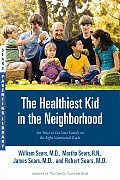
Book Review: The Healthiest Kids in the Neighborhood : Ten Ways to Get Your Family on the Right Nutritional Track


Read and Reviewed for Frontstreet Reviews

Are your kids junk food kids?

Dr. William Sears, a well known pediatrician, has written a book with his wife and two sons (themselves doctors) about getting your kids to eat healthier. He admits that raising healthy kids is getting harder and harder to do. These days, there are fast food restaurants everywhere, school lunches frequently have junk food as a part of the meal, and there is an overabundance of trans-fats and high risk sweeteners in the snacks and foods targeted at children. More and more kids are being diagnosed with illnesses like A.D.D., diabetes, cholesterol imbalances, and being overweight at an early age. These are situations that can be linked directly to the foods that children are eating.

The book is broken down into chapters that first identify good foods and then explain how and why these choices can boost a person's immunity. Another chapter focuses on how to make changes that will result in your children craving healthy foods, not junk, and one that shouldn't be missed talks about how to go shopping with young children and still come home with healthy foods instead of attractively-packaged junk. There are also answers to many nutritional questions that parents may have and a section with kid friendly recipes.

This book is written in a tone that sounds helpful without being preachy. It helps parents learn how to plan meals and snacks that will instill healthy eating habits that will carry over into adulthood. Dr. Sears is able to share with his readers the knowledge and experience that his family has gained throughout the years, and his sons are proof that his methods work. He uses examples of real families throughout the book along with some very helpful advice for both parents and children.

I found the book to be a great reference guide to how different foods help or hinder our health. I especially loved the chapters that broke down the “grow foods” or super foods for kids. They show us why the super foods are super for our children (and us as well) and give us ways to include these foods in our daily eating to maximize their importance to growth and general heath. Most of what was explained should be common sense to the caring parent, however it was great to see Dr. Sears’ advice on what to look for when reading labels, and which vitamins are good to give your children in supplement form to enhance what they should be getting through food. The charts breaking down how much of a mineral you need each day (example iron, and calcium) and the best food sources for those minerals were extremely helpful. This is a book that will be helpful for those parents determined to raise their children as healthily as they can. Whether it is from their child’s first solid food stage, or as an older child that is slowly having his food choices changed from "junk food" to "pure food".

ISBN: 0316060127
ISBN-13: 9780316060127
Publication Date: September 2006
Publisher: Little, Brown & Company
Binding: Paperback

27 September, 2006

Book Review: The Kindergarten Wars by Alan Eisenstock

Read and reviewed for armchair interviews

When you are looking into prospective schools for your children, do you know what sort of questions that you need to ask yours?

Do you know that your answers on the application to questions like “where did you go to college?” may be one of the most important answers you can give. Yes, to get your child into kindergarten.

In these days of public schools getting less and less funding, more parents are turning to private schools to educate their children. Combine that with the fact that it is becoming more and more fixed in people’s minds that in order to get a coveted education at a prestigious university, it helps to have attended the right schools as a child. Also, there are the other facts like more children entering school, and that siblings get first picks at class openings. Competition to get one of the few openings at a private school can be fierce as hundreds of parents compete for the prize of having their child be one of the elite that made it into the class.

Alan Eisenstock has written a narrative book that follows four families through the process of looking at choosing, and applying to enroll their child into the kindergarten of their choice. Each prospective family takes us through the process of visiting schools, applying to them, going through the interview process, and finally the waiting to hear back from the schools as to whether or not their child has gotten one of those few coveted openings. Alan Eisenstock has traveled. The country interviewing the heads of many private schools, he has followed and interviewed many families about the processes and questions that they debt with. His book follows fictional families in a city that could be any big city in the United States. However, he brings us the readers all of the knowledge that he has gleaned from his research to try and answer the one question that parents in the same situations as his families all have:

“How do you get in?”

ISBN: 044657774X
ISBN-13: 9780446577748
Publisher: Warner Books, Incorporated
Publication Date: September 18, 2006
Binding: Hardcover

11 July, 2006

Book Review: Living Well with Back Pain by Robert B. Winter and Marilyn L. Bach


The Authors of Living Well with Back Pain have put together a very comprehensive book on back problems. I loved how early on they broke down the types of back pains and what causes them (complete with illustrations of the muscle systems and the spine). This book easily breaks down how to look up real information on the web, what sorts of questions to ask your doctor, physical therapist, or surgeon about everything from diagnosis to care to operations that may need to be done to your back to help the problems go away, and let you live back pain free. The section that I personally found the most helpful is the one that shows stretches and strengthening exercises to apply towards your back.


ISBN-13: 9780060792275
Publication Date: July 2006
Publisher: HarperCollins Publishers
Binding: Paperback